I write a regular legal column in Design Lines, the national publication for the American Institute of Building Design (AIBD). The last issue included a column about how to fill out the copyright registration form for works of visual arts. You can download the entire magazine, the article is on pages 21-22.
Category: Creativity
December 06 Scene Magazine Column
Mechanical Money
Where’s the real money in music? It’s not in playing cover tunes in bars – sure that’s fun, but you don’t make much money at it. The real money is in writing the songs. When you write the songs, you have multiple avenues of potential bucks including performance rights, mechanical royalties, synchronization licenses, instrumentals/karaoke, lyric reprints in books and magazines, corporate videos, computer games, sheet music, even those damn singing fish and cell phone ring tones.
So how does all this work? First, write the song. Second, spend the $45 to register the copyright in the song. Third, get to work marketing the piece. Let’s look at the three primary moneymakers: performance rights, mechanical royalties, and licensing.
Performance fees are based on feature performances such as visual vocal or instrumental on television or getting big airtime on the radio. These are collected and distributed through complex math by ASCAP, BMI, and SESAC. To get a check, you have to be registered as an artist with one of these three organizations. The money you receive is variable based on which group you join because they all use different formulas to estimate the number and types of performances you song is enjoying.
“Mechanical” royalties are those fees you get whenever someone else uses your song in a CD, Record, Tape, etc. It can get complicated, but to simplify a bit, the artist recording your song must pay 9.1 cents total per copy as a mechanical royalty to the writer and publisher of the song. So, if you write a song that becomes a hit for Beyoncé and sells 10 million copies you’ll split $900K with your publisher. Not bad. Now just imagine you wrote the entire album of 10 songs and you’ll start understanding why Rob Thomas is smiling. It’s important to remember that if you’re recording your own original music as the performer, your record label is going to negotiate a reduced mechanical royalty payment for these “controlled” compositions. If you’re about to cut a CD that includes any cover tunes, be sure to pay those mechanical license fees before duplication or you could be facing some hefty copyright infringement damages.
Getting your song used as part of a TV show, movie, or commercial is what we call a “synchronization license” or “synch.” Think of the theme song for “Friends,” “CSI,” or theme songs to James Bond movies. Publishers can get from about $15K-60K for a movie theme song, and the record company can get about the same for use of the masters. The artist’s cut of that is outlined in their contract, which is why those contracts can get long and complicated. Of course the exposure generated by the show or movie will pump record sales. Product advertising licensing for TV commercials can be a huge source of income for the songwriter: $75K – $750K per year for successful songs. Bob Seger and John Mellenkamp are raking it in for their recent pick-up truck commercial work.
The thing to remember in all this is that almost every license is negotiable, but those negotiations take time and attention. Most musicians I’ve met would rather write and play than read contracts. I can’t blame them, if I had the talent to write hits, I wouldn’t be practicing law!
Granted, there are many songwriters out there and most never make it big. It takes work and it takes luck, but hard workers are always more lucky. If you’re playing cover tunes, start writing and performing original material, sure some people get rich and famous performing other people’s music, but most start by making a name for themselves with their own work.
A great song is your property for 70 years after you die, so leveraging your creativity correctly can provide not only the nest-egg for your own retirement, but the college tuition for your grandkids.
start-up fundamentals
Start-up fundamentals
Business law, intellectual property, brand development, and corporate communications have a very complex interrelationship. Working with Houchin Law and Wooden Pencil simplifies these relationships by combining legal and branding expertise in the same team.
One point of contact, two integrated consulting firms.
Let us help you reach your creative business goals through:
- Business Formation
- Identity Design (Through Wooden Pencil)
- Intellectual Property Planning & Protection
- Stationery and Collateral Design (Through Wooden Pencil)
- Web Site Development (Through Wooden Pencil)
- Contracts & Licensing
- Marketing/Brand Planning (Through Wooden Pencil)
The New Masthead Illustration by Kurt Pfaff ROCKS!
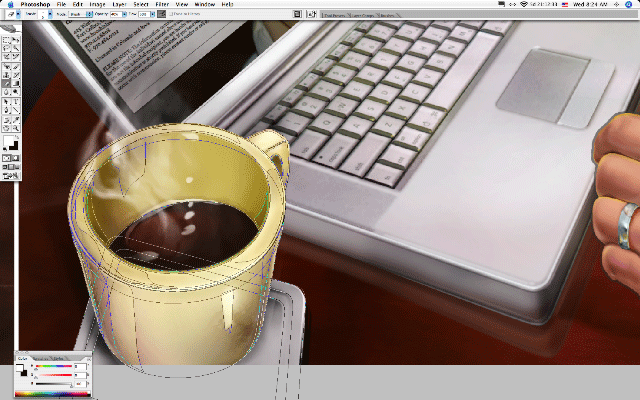
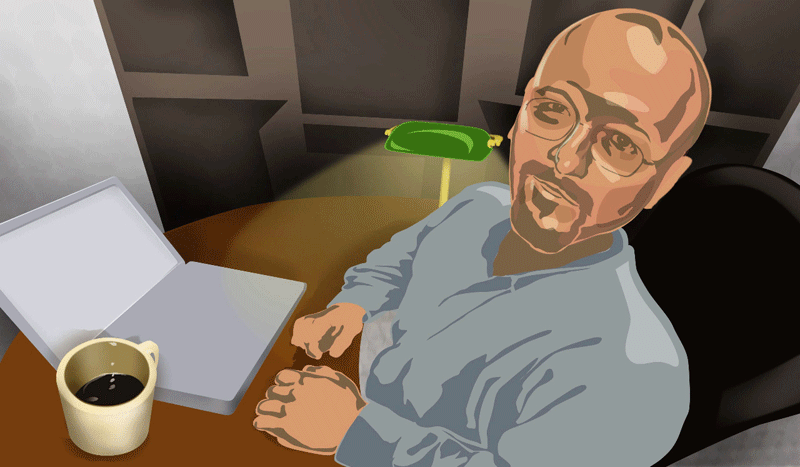
The masthead image is a masterwork of digital illustration by Kurt Pfaff. Kurt’s work is full of wonderful layered detail. Each element is painstakingly created as you can see from the coffee cup detail below. Some elements of the illustration were adapted from reference photography such as the image on the screen of the computer in the illustration, and the batik art-work on the wall in the background of the illustration.
This level of detail and expression shows up in all of Kurt’s work – from editorial illustration like this to his portraiture, biomedical, food, 3D illustration to his work as a logo and packaging designer.
Take a look at Kurt’s work and contact him at http://kurtpfaff.com. His work is worth every penny and you definitely won’t be disappointed!
Coffee Cup Path Detail:
Initial Photo Reference:

Initial Rough Illustration:
Second Draft:

Final Illustration:

Leave some comments and Kudos to Kurt!
The Google Adword TM Trap
Here’s November’s Scene Magazine Article:
The Google Adword TM Trap
By now almost everyone has conducted an Internet key word search using the Google engine. You’ve noticed those “sponsored links” at the top of the results page. If you’re in business and a savvy marketer, you’ve probably thought, “heck, I should probably buy those spots for all my goods and services.” The next step in that logic is to think, “heck, I should probably buy those spots for all my competitors’ goods and services!” “BRILLIANT,” you exclaim as you tally up the keywords in your AdWord buy. What could go wrong?
I wouldn’t be writing a column on the topic if nothing could go wrong – I guess I’m getting predictable. In just the last three weeks I’ve gotten involved in three cases of at least arguable trademark infringement cases involving Company A purchasing the brand name of Company B’s leading product as a key word in Company A’s Google Adword buy. In two of the cases, I’ve been hired by Company B to smack Company A. In the other case, Company A hired me to help them respond to the smack from Company B.
Tough to follow? How about a hypothetical example?
Say I’m our neighbor down the road, Crocs. Say you’re the new guy on the block trying to get a little of that action. You call your product “Snakes” because they make you feel like you’re gliding right down the sidewalk and yet have a nice bite for traction. You decide to get tricky and buy a sponsored link on the search term “crocs.” Are you in trouble?
Not yet, it’s a bit more complicated. First you need to understand that the federal trademark laws are in place to prevent consumers from being confused as to the source of a good or service and by preventing consumer confusion, protect the investment of brand owners in their company’s reputation, goodwill, and marketing dollars. There’s a concept in trademark law called “initial interest confusion” which is when one company unfairly diverts the potential consumer’s attention away from the brand they were looking for over to the competing product at the moment of initial interest, even if there is no confusion at the point of actual purchase. One of my clients said it more understandably, “I feel like he’s fishing off of my hook!”
Now, back to our example; has Snakes violated trademark law by purchasing the Google Adword for “crocs?” Answer: not yet.
The current, but evolving, opinion in the different Federal District Courts around the country is that the simple purchase of the AdWord is legal. To be more precise, the courts have really been addressing the issue of whether or not the SALE of the trademark term is an infringement. The cases have focused on Google (think VERY deep pockets) for contributing to trademark infringement by even allowing competitors to make AdWord buys using trademark terms.
Logically then, it comes down to the advertisement you create on the response page for the key word search you purchased. Google allows a headline of up to 25 characters, two 35 character description or body copy lines, one display Web address of up to 35 characters that is linked to the destination Web page. So, in our example you could place the following text ad.
Headline: Get your Crocs Here
Body Copy: We’re your best source for Crocs
Display URL: www.crocs-r-us.com
The ad would be linked to your “snakes.com” Web site in such a way that the person searching the keyword “crocs” doesn’t know you’re not the real Crocs until they end up on your site. Does that seam fair? Do you think it would cause “consumer confusion as to the source of the good or service?” I sure do, and I’m betting a judge or jury would too. This seems like a clear-cut example of how using the “crocs” name as your keyword buy on Google AdWords would get you into deep trademark trouble.
On the other hand, if you purchase the keyword “crocs” but set up the response ad in a way that clearly does not confuse consumers, then you are arguably using the “crocs” term fairly, at least under current case law. For example, the following ad would be far less likely to confuse consumers.
Headline: Like Crocs? Try Snakes!
Body Copy: Snakes are the best things since Crocs!
Different company, great shoes.
Display URL: www.snakes.com
As I said before, this is evolving law and as such will probably not be settled for a while. Before using a competitor’s brand name in your Google AdWord purchase, be sure to discuss the details of your specific situation with a trademark lawyer familiar with these issues.
##
Kevin E. Houchin is a copyright, trademark, arts & entertainment, and business development attorney located in Fort Collins, Colorado working with creative people and businesses all across the United States. To contact Kevin Houchin, call 970-214-6808 or email him at kevin.houchin@houchinlaw.com.