Open Proposal to Law School Deans and Admissions Directors

In addition to practicing law, I still consult with Law Schools relative to their branding and admissions marketing strategies.  This letter/post is for them.

Dear Law School Leader,

I’m betting you’re not in law school administration for the money. In fact, you probably believe that our society is lead by lawyers, and that lawyers continue to create and shape belief systems established during their law school experience. Why? Because lawyers like you are in your job to make a difference.

I may be the only law school branding and admissions marketing consultant with a J.D. and an active law practice. Because of this, I am continuously motivated to work with law schools, much like you are–to contribute to society. We can do this by working together to shape the law school experience of our future leaders.

We’re probably alike in other ways. For example, you’re probably tired of over-blown, mysteriously-priced proposals from marketing firms chasing your admissions marketing business; I know I’m tired of those. Is your account executive, consultant, and marketing firm actually worth the price of the hidden mark-ups added to their creative services and printing? Maybe, but you simply can’t tell from most proposals or invoices.

So, I’m doing something radically different in the higher education branding and admissions marketing business–making the process transparent.

Proposal: Do you really want to make a difference?

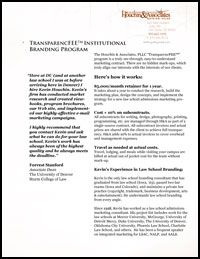
My proposal is simple: for a fee of $5,000/month for 1 year, plus a 10% mark-up on all my out-of-pocket creative and production costs, I’ll plan, direct, and execute top-quality branding and admissions marketing materials for your institution. This includes market research, email marketing, and publications development. For a bit extra, I’ll tackle your Website as part of the project.

Now that’s a deal worth investing in.

I will admit, this model isn’t for everyone; I’m only going to take on 4 clients per year. If you need new admissions materials for Fall of 2008, now is the time to start working on your admissions materials. I’m happy to discuss your situation and preferences. Call me with any questions you have at 970-493-1070 or email kevin@guidingvalue.com.

I look forward to hearing from you soon.

Sincerely,
Kevin E. Houchin, Esq.
Principal Creative and Attorney

For more information on the TransparencFEE program, please download the PDF file below.

TransparencFEE Flier

October Scene Magazine Article

Contract Top 10
© 2007 Kevin E. Houchin

Contracts. Boring and complicated right? Many times yes. But, if you look at a contract as simply a document stating the solution to a mutual problem, like “I have a house that I need to rent or I lose money, and you need a place to live…” then they can be pretty interesting and straight-forward agreements. Remember that a contract is simply the statement of what your mutual promises to each other were when you came to agreement. The rest is easy if your remember these 10 rules.

10. Who?
Are you contracting with one person, a company, several people, several companies, or what? The document needs to identify the people in the game – specifically. It helps to note their form of entity (individual, LLC, corporation, etc.) right up front. I like to also give them a shorter more “normal” name right up front too, like “Kevin” instead of “Kevin Houchin, an individual with business address of…” because it makes the document easier to read than “landlord” or some other alias you normally find in a stock form agreement. If you’re not simply filling in the blanks, saying “Kevin will…” instead of “landlord will…” makes everything easier to follow for everyone.

9. What?
This is the meat of the agreement. What is each party going to do? You know what you promised, so make sure it’s well documented.

8. Where?
If a specific location is at issue, then include it. However, most of the time the “where” refers to where any dispute will be resolved. You generally want a dispute to be resolved in your home state (so you don’t have to pay to travel) using the laws of your home state (so you lawyer doesn’t have to spend as much time researching). Sometimes, it makes sense to have the location in your home state, but applying the law of another state, like California, New York, Delaware, or some other state where the law relative to your situation is better defined, or better for your side of the agreement.

7. When?
What are the deadlines? Is there one, or several? Again, make sure to document the agreement you’ve discussed and have in mind. Try to eliminate assumptions. Don’t just assume your customer/client understands an “industry standard.”

6. Why?
Most of the time the “why’s” aren’t binding and get included at the front of the agreement under a bunch of “whereas” statements. I like to use a bunch of these to set the stage for a smooth negotiation. For example, “Whereas X is a highly respected expert in Y industry…” set the stage for X to feel good about going into the details of the agreement. Buttering someone up a bit always helps because you DO catch more flys with honey.

5. How Much?
Again, be specific. Use flat rates or formulas. If there’s a formula involved, give an example of how something seemingly confusing is easily resolved through the formula. If you can’t figure it out now, you won’t be able to agree on it later.

4. How Often?
Lots of times people agree to contracts that pay them something like 10% of net receipts of widget XYZ. That’s fine, but how often are the payments made?

3. What if?
What if we decide this was a stupid deal and we hate each other? How do we get out? If we kill the deal, how much notice do we have to give. If someone has lied and we end up in court, do they have to pay our damages and costs (called an “indemnification” clause)?

2. Writing.
Verbal agreements are binding in most cases. The issue is proving the TERMS of the agreement. That’s what the writing is all about – proof. The writing doesn’t have to be in a special font, on white paper, notarized, or much of anything in most cases, so get SOMETHING down on paper and have the other person give some sort of written assent to the terms. An email will work in most cases. Just make sure you have some form of record that the person you’re agreeing with has agreed to the terms you expect. A formal, but unsigned document is NOT going to help much – in fact, an unsigned document might arguably prove that the other side did NOT agree to the term in dispute.

1. Purposeful Ambiguity.
“Purposeful Ambiguity” is a technique I use to get past a term in a deal that has a very low probability of happening, but could pooch the deal if we can’t get past it. The word to remember here is “reasonable” for instance, “Kevin will use reasonable efforts to sell the widgets.” This let’s us get going on the project, without arguing over something that we don’t need to fight over now. Granted, it’ll be the lawyers, judge, and/or jury defining what “reasonable” means, but that’s a risk we might be willing to take.

Contracts don’t have to be complex or difficult. They don’t even have to anticipate every detail. They just have to document the agreement so that all parties understand what’s on the other party’s mind.

Kevin E. Houchin is principal of Houchin & Associates, PLLC – a copyright, trademark, arts & entertainment, business development, and branding firm located in Fort Collins, Colorado. To contact Kevin, call 970-493-1070 or email kevin.houchin@houchinlaw.com.
September 2007 Scene Magazine Article: TM Myths

OOPS!  I forgot to post this earlier this month…

Trademark Myths
© 2007 Kevin E. Houchin

There’s a lot of misinformation floating around the business world about trademarks. Smart business people are waking up to the fact that this area of LAW is critical to successful BRANDING, which as we all know is the foundation of sales, revenue, and ultimate business success or failure. It doesn’t matter if you are selling widgets, houses, luxury cars, guitars, or brooms – your brand is one of your biggest assets, and trademark law is the protective mote around your brand. Here are top mistaken assumptions business people tend to make about trademarks.

10. I changed a letter and got the domain name, so I’m OK.

Wrong! The test for trademark infringement is not if a letter or word is different. It’s whether or not consumers would be confused as to the source of the goods and services.

9. Someone else is already using the name, but they haven’t filed a registration, so if I file first, I’ll be OK.
Wrong! The tests for trademark infringement isn’t who registered first, it’s who used the trademark in commerce first.

8. Just using the “TM” symbol gives me all the protection I need.
Wrong! While it’s smart to use the “TM” symbol next to anything you want to claim as an indicator that your company is the source of the goods and services, just using the “TM” will not give a generic or merely descriptive trademark any protection unless you can prove the trademark has achieved what’s called “secondary meaning” in your marketplace.

7. I can use my competitor’s brand in my Google Adwords buy without any problems.
Wrong! Just because Google doesn’t check for trademark infringement and will let you place the ad doesn’t mean your competitor won’t be ready to slap you with an infringement suit if you use their name as a keyword to distract consumers from their site and lead them to yours.

6. I own the domain name, so I can stop anyone else from using something similar.
Wrong! Even if you got there first to register a domain name, the test is who USES the mark first. Sitting on a domain name doesn’t count. Launching a Web site that includes the name for a product, but not actually selling the product, doesn’t count. You have to use the name appropriately to get protection, which means if you’re offering a product, the name has to be on the actual product. If you’re offering a service, then a Web page is usually good enough.

5. I filed the LLC papers with the Secretary of State on this name, so I’ll be OK.
Wrong! Filing your name with the Secretary of State is basically the same as getting the domain name.  Their test is just if the string of letters is different. Again, trademark infringement is about consumer confusion, which is a much more difficult standard than just changing a letter or two.

4. As long as I’ve used my product or company name in commerce, nobody else can use it for anything.

Wrong! You could have a great trademark for a marketing firm, but I could potentially use that name for my line of clothing – as long as we’re marketing to different people and my customers wouldn’t be confused about whether you are the source, sponsor, or are otherwise affiliated with my products. Again, it’s about consumer confusion, and that’s sometimes hard to define.

3. I paid the $50 to register my trademark with the secretary of state, so I’m covered.
Wrong! You’re probably covered in Colorado (or whatever state), but that does nothing for your business with people in any other state. State-specific trademark filing is practically a relic from the pre-internet days when it took more than just launching a Web site to have an interstate or international business presence.

2. I’ve invested a lot of money in this name, logo,  stationery, and marketing materials, they can’t just make me toss it all and start over.
Wrong! This is exactly what a prior user can make you do, and make you pay damages and/or profits on top of that. It’s just this risk that makes investing a branding strategy that doesn’t include a trademark plan such a dumb move.

1. I have the domain name and I use the “TM” on my stuff, so it’s not worth the expense to register my trademark.
Wrong! Having the domain name is a good indicator these days that you’re the first user of the mark, and using the TM is very effective at putting potential infringers on notice that you’re claiming the mark as an indicator of source for your goods or services. However, in today’s competitive market place, registering the trademark with the United States Patent and Trademark Office is in most cases worth the expense if you think you will ever need to enforce your rights. The power of the registration will both increase the chance of a quick resolution, and lower the litigation costs of an infringement suit.

Kevin E. Houchin is principal of Houchin & Associates, PLLC – a copyright, trademark, arts & entertainment, business development, and branding firm located in Fort Collins, Colorado. To contact Kevin, call 970-493-1070 or email kevin.houchin@houchinlaw.com.