I’ve been thinking a lot lately about the intersection of law, business, creativity, and spirituality. I’ve been listening to some recordings of Joseph Campbell and reading his work, along with a lot of other great thinkers. Here’s what I’ve come up with:
Law enables Business
Business is the vehicle for our Creativity
Creativity fuels the spark of divinity within our Spirit
Spirit should inform Law
Here’s a visual model of what I’m talking about:
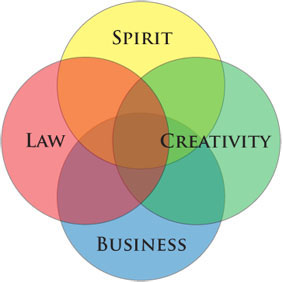
When you see it this way, you also see that Law effects Creativity – in a left-brain (law) v. right-brain (creativity) sort of relationship. Business and Spirit also interact in a quasi-kabbalistic way with Spirit on a “higher” plane manifesting on the material plane in the form of business.
I think it’s worth examining these relationships, especially in the areas of the overlap.
How can we get more spiritual influence in our legal policy? Should we? I’m not talking RELIGION, I’m a firm believer in the separation of Church and State. I’m talking about SPIRIT – or at least the golden rule, should infuse all of our laws. Can we overcome the greed and short-term self-interest that seems to motivate our law-makers and lobbyists working behind the scenes? Maybe that’s naive, but I think we need to start somewhere.
How can we get more people, especially small business folks (the backbone of our country and future), to understand and engage in the aspects of the law that KEEP them out of trouble rather than waiting until they’re neck-deep in bad stuff to ask for help? It seems that people get upset that legal fees cost so much – but they usually are only engaging with lawyers AFTER they’ve gotten in trouble. I can guarantee that it costs way more to get out of trouble than to avoid it in the first place.
How can we get more spiritual inspiration happening in our businesses? Maybe that’s simply through the Creative process itself. Maybe the role of Creativity is simply to channel a spiritual aspect of existence into our daily lives, which tend to revolve around business. Maybe our arts organizations need to take on more outreach programming (if possible) rather than constantly trying to just get people to come to the museum, symphony, etc. (Of course I recognize that many arts organizations already do great outreach programs.) How can we get more Creative inspiration infused into our legal framework at the national, state, and local levels?
I think if you have read books like Dan Pink’s A Whole New Mind, watched Shift Happens on YouTube, engaged in Bruce Mau’s thoughts of Massive Change or even just been allowed to lift your head up out of the cubical and take a fresh look around – these questions should be bubbling in your subconscious.
To use some of the language of Joseph Campbell, I think American Culture is hearing “the call” of the “hero’s journey” into some challenges that we need to face head-on, or be forced to face in a bad way (much like those small business owners who wait until after the trouble starts to create a plan). Maybe an understanding of the interactions above might help us in that quest.
I’m no expert on these topics. I’m as guilty as the next person (maybe more so) of waiting until I’m in trouble to start finding a way out, but I think these issues are too important to ignore. Maybe that’s just me, but I don’t think it is this time.
I’d really like some feedback on this topic and I’ve enabled the commenting feature on the blog again (thanks to some blog-spam software that seems to be working). So, feel free to chime in with your thoughts on this or other things I should be considering. I’m going to keep exploring and writing on these issues and hearing (and sharing) some different perspectives would be great.
