the business of creativity

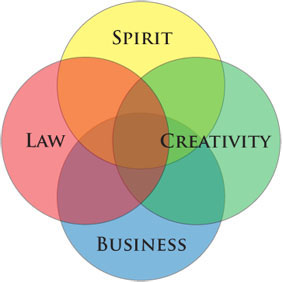
I’ve had several conversations with friends and clients over the last few days specifically addressing how to frame the discussion of law, business/art, creativity and spirit in some understandable form. The phrase that keeps coming up and helping people understand what this is about seems to be “The Business of Creativity” where the law element is included in the business/art discussion and the spirit element is rolled into the creativity discussion. I don’t know yet if this really works for me yet because I don’t know if I want to down-play the spirit discussion at all. Maybe I won’t have to short-change the spirit, but I’m not seeing how “the business of creativity” captures everything I want to say. It definitely captures a sub-set VERY well. I pay the bill by helping people with the business of creativity, but there’s more to it.

I’ve been thinking about negative space – the space between objects and classifications. If you think about the numbers 1, 2, 3, etc a little bit, it’s easy to see that these numbers that we think of as “whole” are really an infintesimally small point along the number line. There is an individual infinity between 1 and 2, another between 2 and 3. So, when we think about the “whole” numbers, we’re missing a very great deal of good stuff in the spaces between. I don’t want to make that mistake when discussing spirit, creativity, business/art, and law.

I don’t want to get so focused on the labels or “poles” that the relationships between the poles are not given full attention. It’s the overlap that’s interesting. Perhaps it’s the overlap that gets closest to “real.”

In effect, these poles are only “real” when they are relating to each other, and relating to a whole host of other concepts that are outside of my focus. You could say they are in relation to each other, but maybe the “relation” should be spelled “realation” in this discussion. How about “inrealation” as a unifying label for the discussion? I like that. Inrealation.

What do you think?  Post a comment…

Back on Track

I’ve been thinking a lot lately about the intersection of law, business, creativity, and spirituality. I’ve been listening to some recordings of Joseph Campbell and reading his work, along with a lot of other great thinkers. Here’s what I’ve come up with:

Law enables Business

Business is the vehicle for our Creativity

Creativity fuels the spark of divinity within our Spirit

Spirit should inform Law

Here’s a visual model of what I’m talking about:

Back On Track Model

When you see it this way, you also see that Law effects Creativity – in a left-brain (law) v. right-brain (creativity) sort of relationship. Business and Spirit also interact in a quasi-kabbalistic way with Spirit on a “higher” plane manifesting on the material plane in the form of business.

I think it’s worth examining these relationships, especially in the areas of the overlap.

How can we get more spiritual influence in our legal policy? Should we? I’m not talking RELIGION, I’m a firm believer in the separation of Church and State. I’m talking about SPIRIT – or at least the golden rule, should infuse all of our laws. Can we overcome the greed and short-term self-interest that seems to motivate our law-makers and lobbyists working behind the scenes? Maybe that’s naive, but I think we need to start somewhere.

How can we get more people, especially small business folks (the backbone of our country and future), to understand and engage in the aspects of the law that KEEP them out of trouble rather than waiting until they’re neck-deep in bad stuff to ask for help? It seems that people get upset that legal fees cost so much – but they usually are only engaging with lawyers AFTER they’ve gotten in trouble. I can guarantee that it costs way more to get out of trouble than to avoid it in the first place.

How can we get more spiritual inspiration happening in our businesses? Maybe that’s simply through the Creative process itself. Maybe the role of Creativity is simply to channel a spiritual aspect of existence into our daily lives, which tend to revolve around business. Maybe our arts organizations need to take on more outreach programming (if possible) rather than constantly trying to just get people to come to the museum, symphony, etc. (Of course I recognize that many arts organizations already do great outreach programs.) How can we get more Creative inspiration infused into our legal framework at the national, state, and local levels?

I think if you have read books like Dan Pink’s A Whole New Mind, watched Shift Happens on YouTube, engaged in Bruce Mau’s thoughts of Massive Change or even just been allowed to lift your head up out of the cubical and take a fresh look around – these questions should be bubbling in your subconscious.

To use some of the language of Joseph Campbell, I think American Culture is hearing “the call” of the “hero’s journey” into some challenges that we need to face head-on, or be forced to face in a bad way (much like those small business owners who wait until after the trouble starts to create a plan). Maybe an understanding of the interactions above might help us in that quest.

I’m no expert on these topics. I’m as guilty as the next person (maybe more so) of waiting until I’m in trouble to start finding a way out, but I think these issues are too important to ignore. Maybe that’s just me, but I don’t think it is this time.
I’d really like some feedback on this topic and I’ve enabled the commenting feature on the blog again (thanks to some blog-spam software that seems to be working). So, feel free to chime in with your thoughts on this or other things I should be considering. I’m going to keep exploring and writing on these issues and hearing (and sharing) some different perspectives would be great.

Rune’s Journal

My son Rune will turn 6 in January.  Earlier this year he took an interest in the journals that Abra and I normally keep. He kept wanting to write in mine, which is OK every once in a while, but it seemed the right time to get him his own “special book.”  He’s really taken to it.  Tobin (4) has one too, but it’s not quite kicked in with her yet – so it seems like 5 years old is a great time to start kids journaling.

He gave me permission to share one of his favorite pages.  It’s a work in progress. He adds stuff on this page almost every session.

Oh ya, he uses a fountain pen!  🙂

Click on the Thumbnail below for a larger view.

Rune's Journal Thumbnail

(c) 2007, Rune Cleo Houchin, Age 5.

If You Insist

If You Insist
© 2007 Kevin E. Houchin

In the past month I’ve had several people in the office with messed-up corporate situations. I’m not going to preach (much) about how it costs way more to get out of trouble than to have avoided it in the first place, but just know that the legal bills to sort out these messes are probably going to be ten times the price of correctly forming a company from day one.

Most of the time, companies are easy to set up. The buy-sell agreement is usually the most challenging part. However, to effectively set up a corporation, you need to jump through more formal hoops, and the companies I’ve been talking with lately simply didn’t make the right jumps.

So, if you insist on forming your own corporation without the assistance of a lawyer, here are my thoughts on the minimum amount of work you need to complete.

1. Set up the entity on the Secretary of State Web site.
This is the easy part. The filing fee is only $25.00. The biggest mistake people make on the form is messing up the authorized shares listing. Your initial authorization of shares is an important decision and it depends on a bunch of factors relating to the number of owners involved at incorporation, or expected in the near future. I suggest authorizing 100,000 shares. This gives you some room to work, as I’ll discuss below.

2. Get an EIN number from the IRS.
Again, this is easy. Go to www.irs.gov and follow the instructions.

Unfortunately, most people stop here and head to the bank. The bank doesn’t care about many of the details and formalities. If you insist on conducting business in the corporate form, you need to complete the next several tasks.

3. Adopt a set of corporate by-laws.
These are the rules about how your company will be managed. The way you go about adopting these agreements is by holding an initial meeting of incorporators in which you make resolutions to play by these rules.

4. Adopt a buy-sell agreement.
This document regulates the purchase and sale of your corporate shares. It should include a valuation formula for the business and the rules for leaving or pushing someone out. This document is critical. Getting into business with someone is like a marriage except the owners generally can’t kiss to make up. The buy-sell agreement is the business equivalent of a pre-nuptial. Don’t go into business without it.

5. Create and accept subscription agreements.
These letters are the written offers from the initial shareholders to purchase shares of the corporate entity for some amount of value – usually cash. I have all the initial shares issued to the initial owners add up to LESS than the full number of shares authorized in the Secretary of State filing. Having some shares that are not “issued” at formation makes it way easier to bring in future owners, because then you just have the new shareholders buy their shares directly from the corporation rather than from the initial individual owners. Doing this also saves making another filing with the Secretary of State to authorize additional shares.

6. Create share certificates.
Share certificates are proof of your portion of ownership in the company. It’s hard to prove you own “shares” of a corporation when you don’t have the actual “share certificates.” Amazingly, people have been known to invest a lot of money as an “owner” of a corporation without ever seeing a share certificate. Don’t let that be you. (Of course the exception to this rule is buying shares in publicly traded companies. Your brokerage firm holds those share certificates.) You can order corporate kits online with a seal, share certificates, and standard by-laws that allow you to just fill in the blanks. Be careful just filling in the blanks, because standard forms might not fit your specific situation, but filling in the blanks is usually better than ignoring the document completely.

7. Elect a Board of Directors.
Your Board of Directors runs the company on behalf of the shareholders. In most small “closely held” corporations, the list of board members and the shareholders are virtually identical. As the company gets bigger you might have shares held by folks who are not actively involved in the business. Remember, in a corporation, the Board makes the decisions on the day-to-day management. The Board can be one person, or as large as you want (as specified in the By-laws you adopt). If you have several shareholders you should have at least a President, Secretary, and Treasurer as officers of the Board of Directors. At least two of these people should be required to approve any serious action of the corporation. There are additional rules for certain corporate actions that require shareholder approval, such as selling the company.

8. Bank Accounts
I’ve seen several situations where there was no direction or restrictions put on the bank accounts, which resulted in one person transferring all the money out of the corporate account or taking another owner’s name off the account. If you want to protect the corporate money, then protect the corporate bank account. Require corporate action signed by two directors (President, Secretary, and/or Treasurer) before someone’s name can be taken off an account. Require two signatures for transfers over certain dollar amounts or for transactions that would bring the account to a zero balance. Talk with your banker to effectively establish these practices right up front. Don’t get burned by finding out your co-owner has just cleaned out the funds and taken your name off the corporate account.

If all this sounds like too much work, reconsider your venture, or hire professional help.

Kevin E. Houchin is principal of Houchin & Associates, PLLC – a copyright, trademark, arts & entertainment, business development, and branding firm located in Fort Collins, Colorado. To contact Kevin, call 970-493-1070 or email kevin.houchin@houchinlaw.com. Download Kevin’s FREE ebook: “Strange Fire: 5 Winning Principles” at www.guidingvalue.com.
A Whole New Mind

Everyone should read this book.  It should be required reading in high schools, then again in undergraduate program, another time in graduate schools, and once a year for all parents and teachers.

http://www.danpink.com/aboutwnm.php

I lifted this from the site link above:

“Lawyers. Accountants. Radiologists. Software engineers. That’s what our parents encouraged us to become when we grew up. But Mom and Dad were wrong. The future belongs to a very different kind of person with a very different kind of mind. The era of “left brain” dominance, and the Information Age that it engendered, are giving way to a new world in which “right brain” qualities-inventiveness, empathy, meaning-predominate. That’s the argument at the center of this provocative and original book, which uses the two sides of our brains as a metaphor for understanding the contours of our times.”